

Being an aviation artist I have had and continue to have the honour of painting many WWII scenes featuring a wide range of military aircraft. But it's not just about the aircraft. The paintings to follow all have a story behind them; describing the aircraft, brave crew, the mission/operation they were assigned to and the outcome.
You will find a product link below any painting that's available as limited edition prints.
QUEENIE
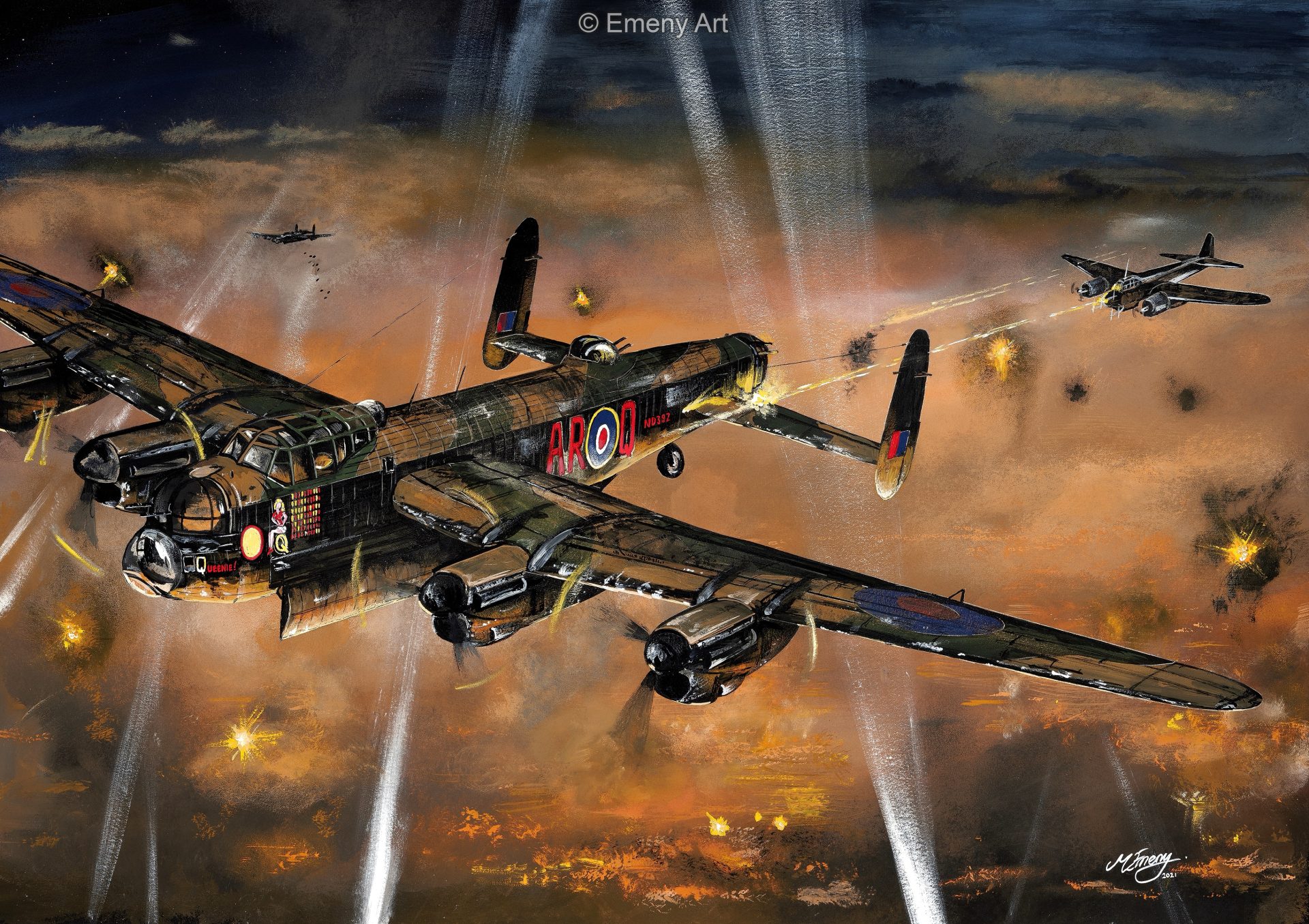
Lancaster "Queenie" ND392 (AR-Q) 460 Sqn RAAF, RAF Binbrook.
The painting depicts the events on the night of 22nd March 1944 at around 2200 hours, when the crew were nearly all killed after their Lancaster was attacked by a Ju88R north of Frankfurt. They managed to survive, deliver their bomb load over the target and return safely to base in their badly damaged aircraft.
Upon landing at RAF Binbrook, they found a tracer shell had made a furrow all along one fuel tank and had burned itself out, but not pierced the tank. If it had, the plane would have basically exploded with about 55% fuel as well as the full bomb load.
The Canadian mid upper gunner baled out and became a POW and the rest of the crew had no choice but to return to base as their parachutes were damaged. The tail gunner, who never saw the attacking night fighter, was badly wounded but survived.
The mainly Australian crew were decorated for their heroism; with Scottish Engineer Hendry, and W/Op Cochrane receiving the DFM for physically holding the plane together all the way home, as the pilot, Reg Mullins, was unable to fly the aircraft without their assistance.
PANHANDLE DOGIE - LAST FLIGHT
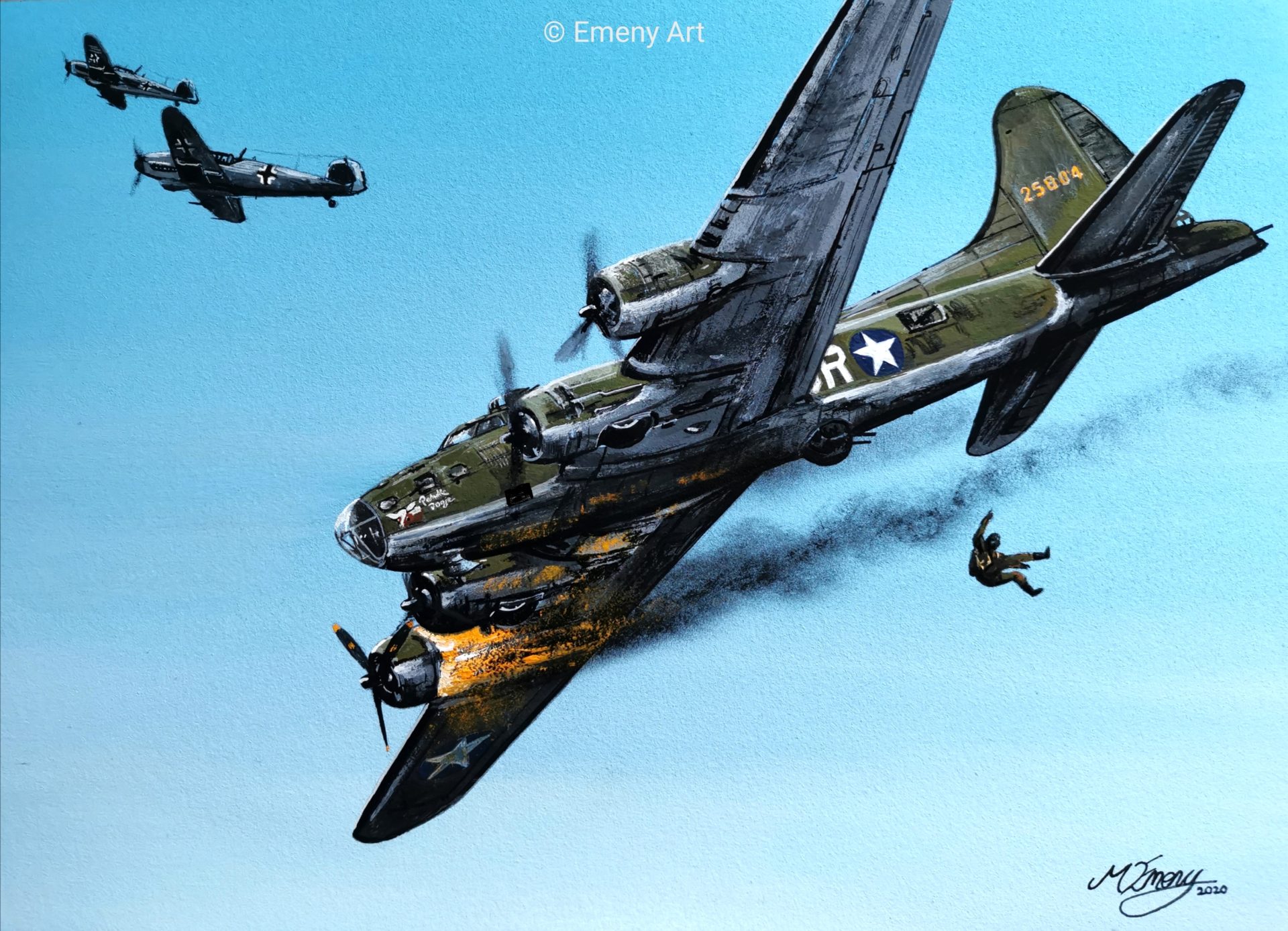
A tribute to the crew of B- 17f 'Panhandle Dogie' from 91st Bg, 323rd Sqd. It was to be a fatal mission to St Nazaire on Jan 3rd 1943, when the aircraft was shot down by enemy fighters. Only the Navigator managed to jump clear of the bomber (sole survivor). Fire was also seen in the bomb bay which likely explains why no other crew members made it out. Shortly after the aircraft exploded over the sea, tragically killing those left onboard.
MAULING THE MIDNIGHT MARAUDER
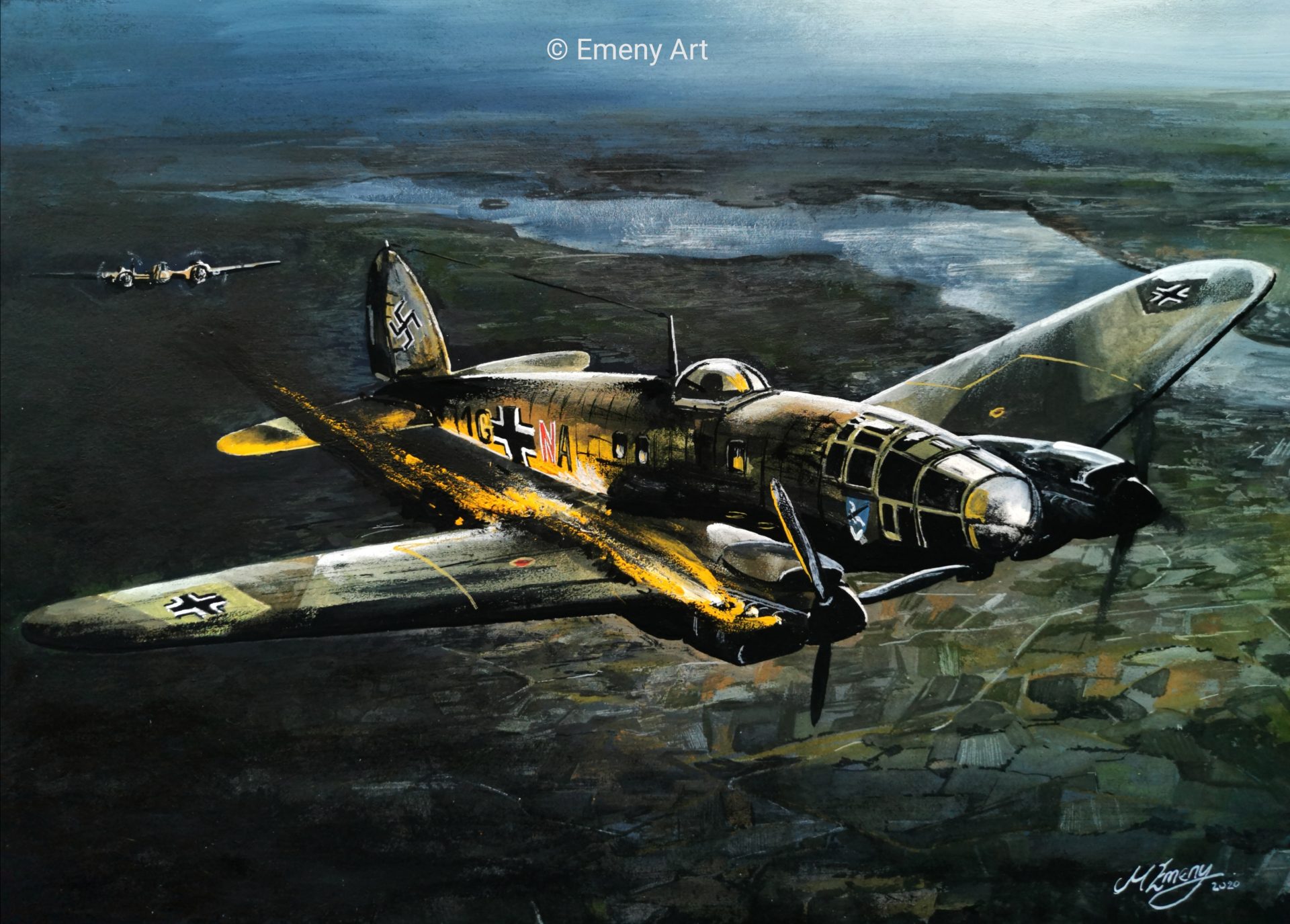
This was a painting I created for someone who had a data plate from the downed HE111 H-2 which he and his partner found at the crash site! I was asked to paint a scene depicting the event.....
The Heinkel featured was HEIII H-2 Werke Nr1647of KG27. It was based at Tours, France and it's target was Liverpool. It was intercepted at 23.50 Hours on the 7/5/41, by Beaufighter Mk IIF of 600 Squadron based at R.A.F.Colerne. Flying Officer G Howdens and its Radar Operator was Sergeant Fielding.
All of the below mentioned Heinkel crew bailed out successfully. The crash site was located and excavated in the 1980s by the Severnside Aviation Society. Very little was found as the aircraft burnt fiercely on impact. The crash site location is between Langford and Wrington.
Oberfeldwebel Heinz Ronge (Pilot), Oberleutnant Johannes Maron (Observer), Feldwebel Heinz Dietrich (Radio operator), Uneroffizier Heinrich Eggert (Flight engineer), Gefreiter Helmut Hilger (Gunner)
GIL'S DOWN
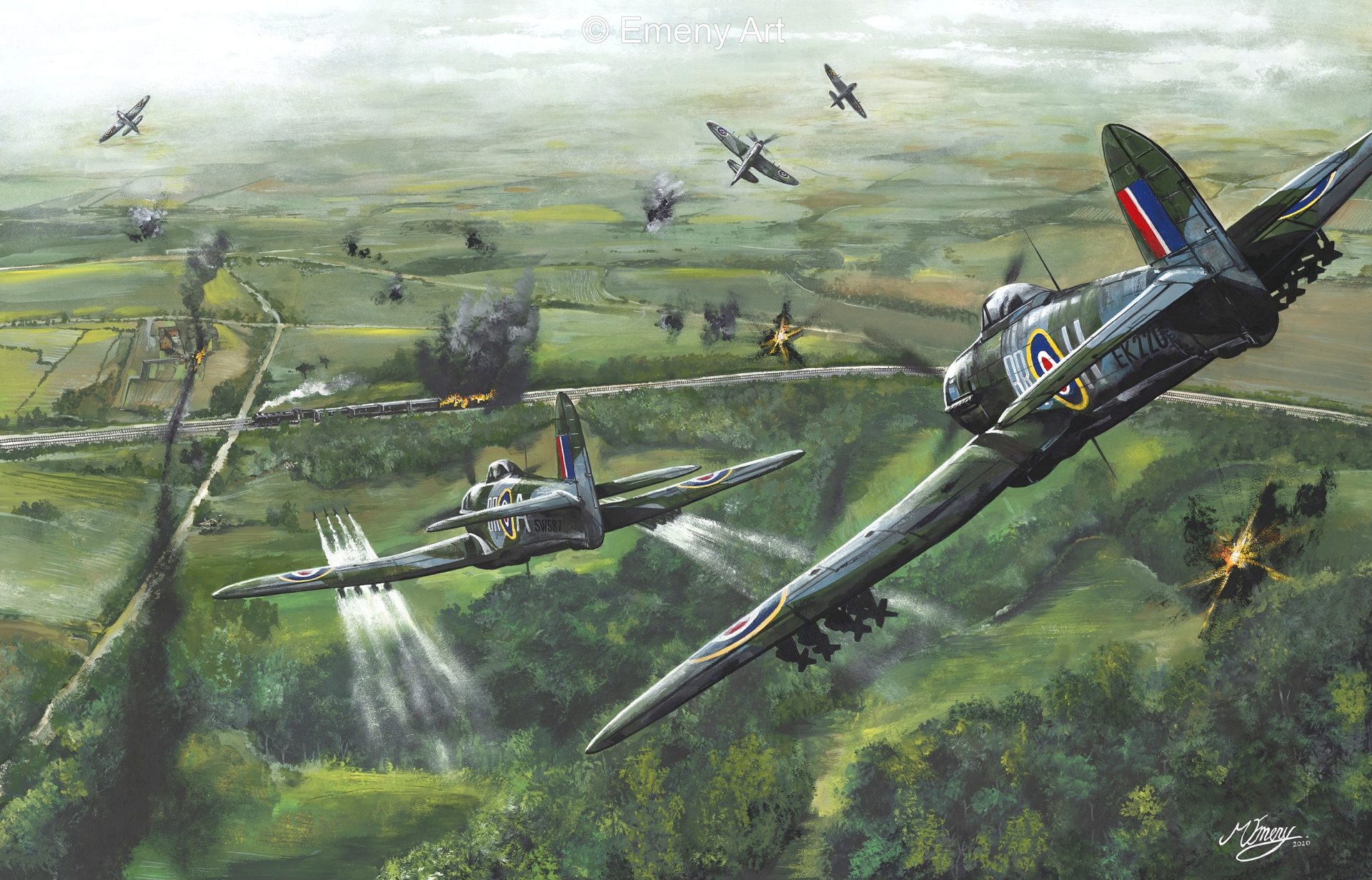
Depicting 184 Squadron Hawker Typhoons during a mission that took place on 25th April 1945 near Schwarzenbek, Germany. Eight Typhoons in total were attacking what was initially identified as a German Flak train. It wasn't until after the engagement and subsequent witness reports that this was revealed as a passenger train being defended by mobile Flak units. These misjudgements were a sad reality of war and referred to as the 'fog of war'. In situations where pilots are in rapid descent whilst under fire, it is understandable how target assessment can be clouded.
During the strike Red Leader F/O Gil Gilham from the first wave was hit by flak and crashed into a farm field. The paintings title is reference to the other pilots realisation that Gil had been hit.
NEVER GIVE UP, NEVER FORGET
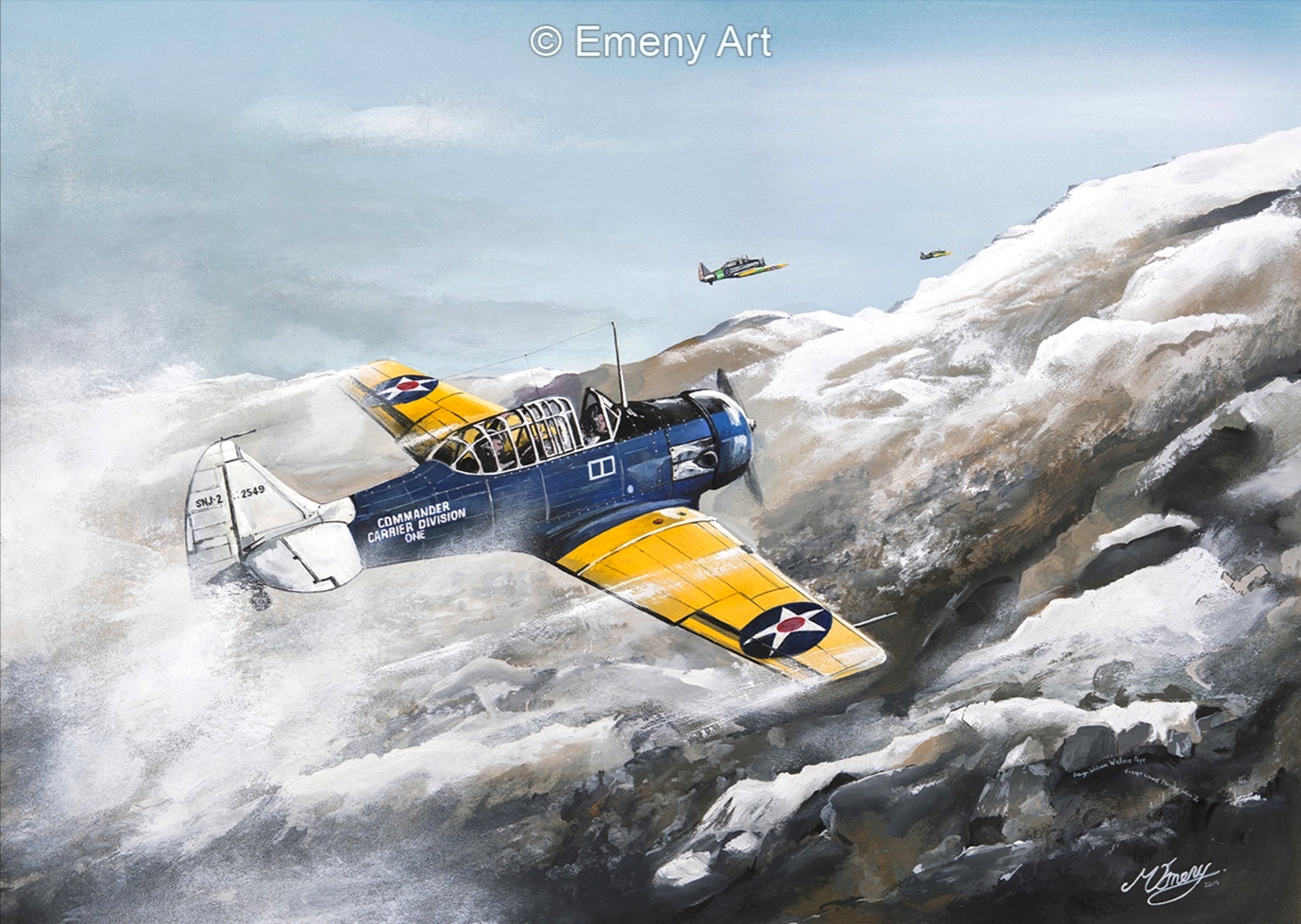
13th February 1942 during the final leg of a delivery flight from the factory; four Grumman F4F-4 Wildcats encountered severe weather conditions en route to NAS San Diego. Overdue at their destination, search missions commenced the following day to locate the missing pilots. Participating in the search was North American Aviation SNJ-2 BuNo 2549; piloted by Ensign William Wallace Page and accompanied by observer Ensign Louis Massie Winn Jr; flying in a wing position of a three plane section over the southern Santa Rosa Mountains. SNJ-2 BuNo 2549 disappeared during the search in the vicinity of Rabbit Peak and this painting depicts their final moments.
September 1944 the original flight leader of the search, Lt. Commander James Franklin Patterson never gave up and resumed searching by air, later successfully locating the wreckage of the SNJ. Following a gruelling three day hike up Rabbit Peak by Patterson, accompanied by a company of Marines, the bodies of the ensigns were recovered and returned to their families to be buried with full military honours. The wreckage of BuNo 2549 would remain atop the mountain and recovered fifty years later in the early 1990’s.
THE LT. COLEMAN B-24 CREW
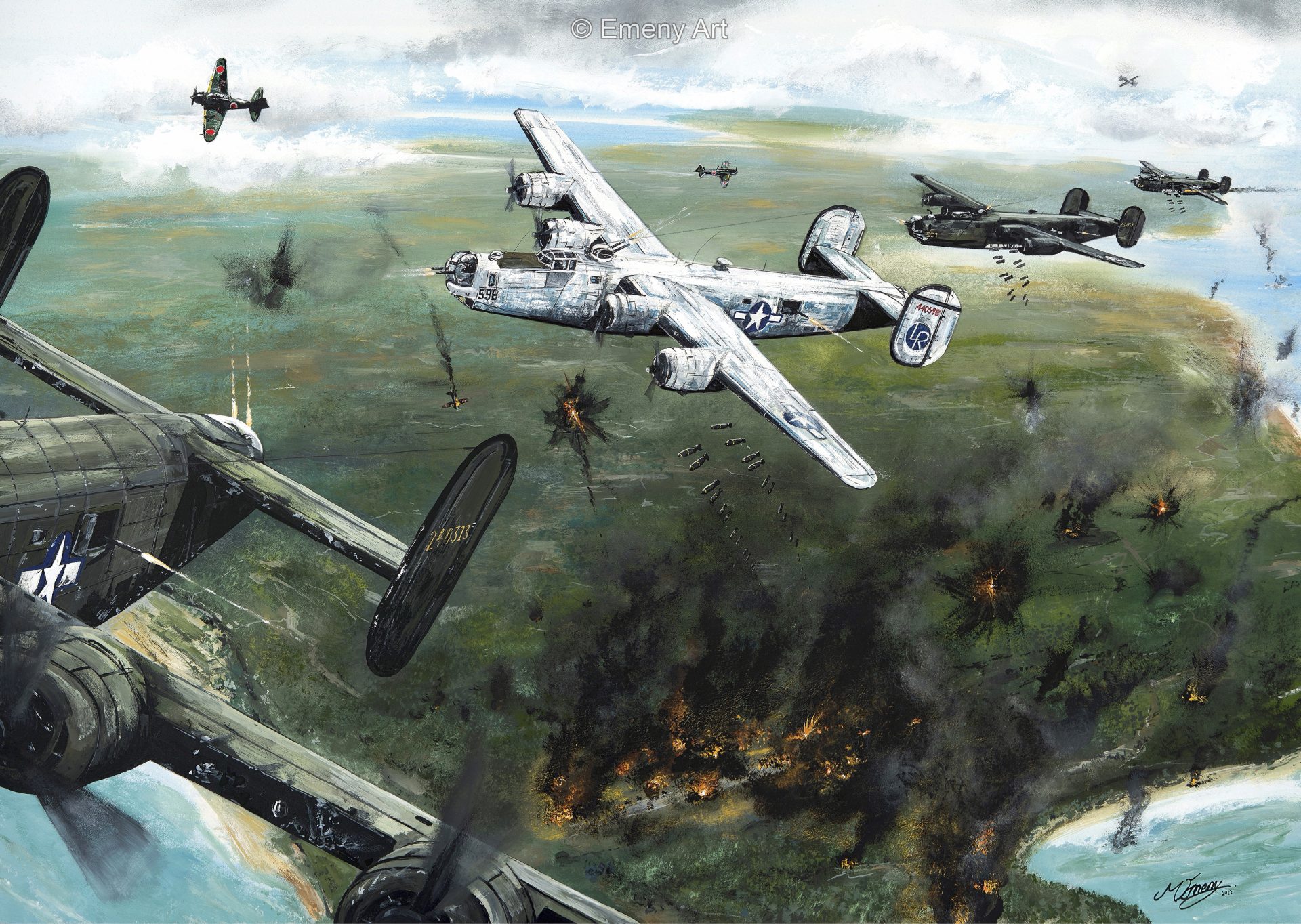
Featuring a B-24 bomb raid over Yap Island, targeting the airfield. The main B-24 depicted is a 'J' variant #44-40598, recently off the production line and unpainted. The name taken from the pilot Lt. Gerald Coleman.
The crew was part of the 13th Air Force, 307th Bombardment Group and 372nd Squadron. On June 25th, 1944, they bombed Yap along with four other squadrons.
Tragically, after bombs away their plane was shot down by a Japanese Zero that did a head-on pass. Their cockpit was hit with 20mm shells likely killing the pilots. The plane crashed in the water two miles south of the airfield. No parachutes were seen.
THE VALKYRIES BECKON
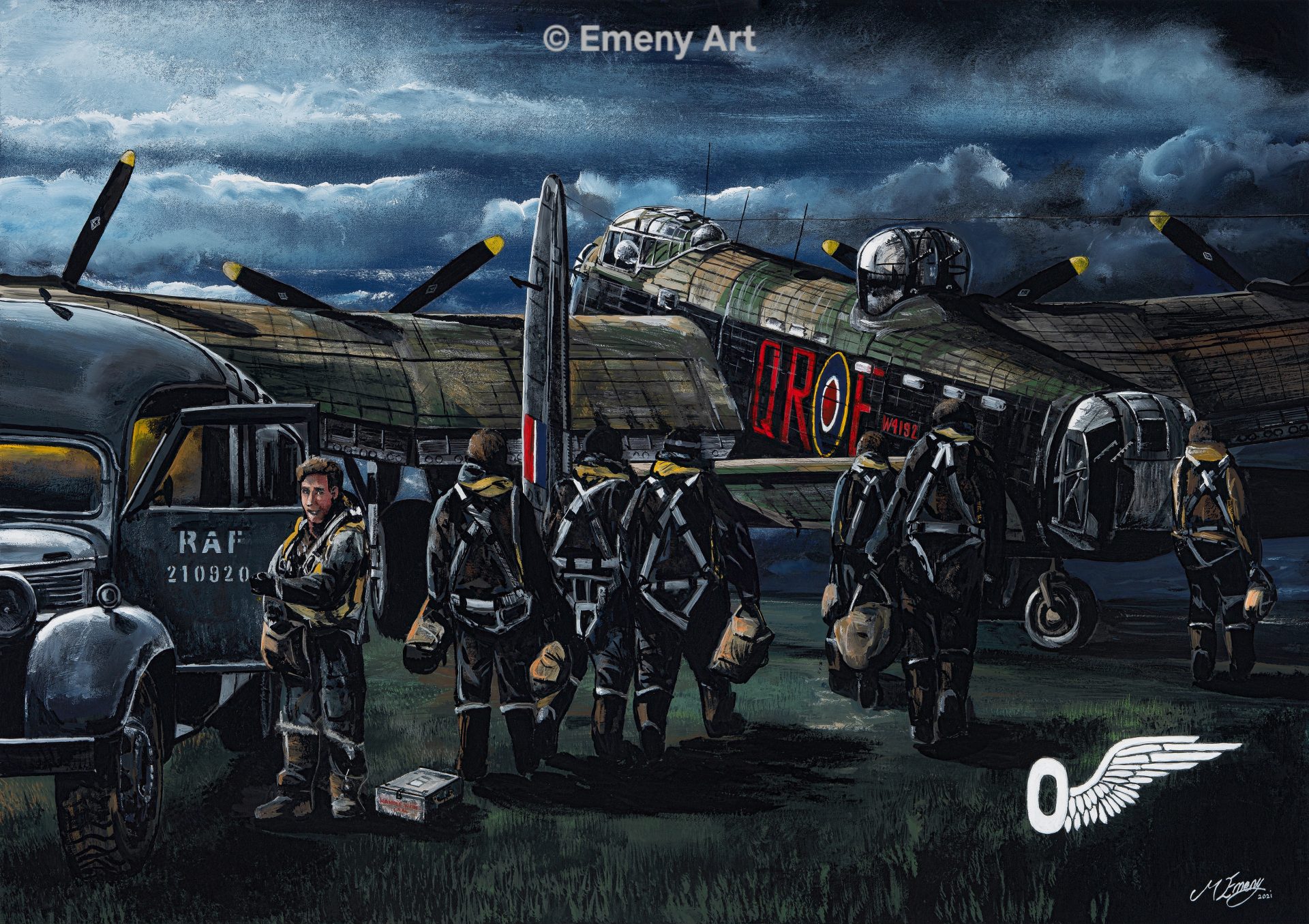
FO John Northend was navigator on board Lancaster MkI W4192 ‘QR-E’. In the scene he is standing by the crew wagon. The aircraft took off at 03:35hrs on 13th January 1943 from RAF Syerston, along with other Lancaster bombers of 61 Sqn, (No.5 Group) RAF. They were part of a force of 55 Lancasters from Nos. 1 & 5 Groups with target indication by 4 Mosquito aircraft from the Pathfinder Force, taking part in an attack on the Krupps works at Essen, one of the cities in the industrial heartland of Germany, the Ruhr.
Tragically their Lancaster crashed on the return leg at Mettman, 14 km ENE of Düsseldorf, where the crew were all killed. They were originally buried in Nordfriedhof on 18th January 1943, but they were reinterred in the Reichswald Commonwealth War Graves Commission Cemetery. It is not thought that they were shot down by a night fighter as there were no outstanding claims, but it is believed that they may have been damaged by flak over the target.
FO John Edward Northend was the son of William and Phyllis Northend, and was born on the 21st September 1920 at Sheffield in the West Riding of Yorkshire. His father William Frederick Northend was a veteran of the Great War, having served in the 1/3rd West Riding Field Ambulance, Royal Army Medical Corps in the 43rd W Riding Division. FO John Northend was appointed as Sgt aircrew sometime in 1941 under service number 1378643 and was appointed to an emergency commission as a Pilot Officer in the General Duties Branch of the RAFVR on 31st January 1942. He was posted to No 61 Sqn at RAF Syerston and it is believed he was promoted to Flying Officer on 1st October 1942.
This painting is a tribute to FO John Northend and the other crew who lost their lives that day. R.I.P.
INTO THE DARKNESS
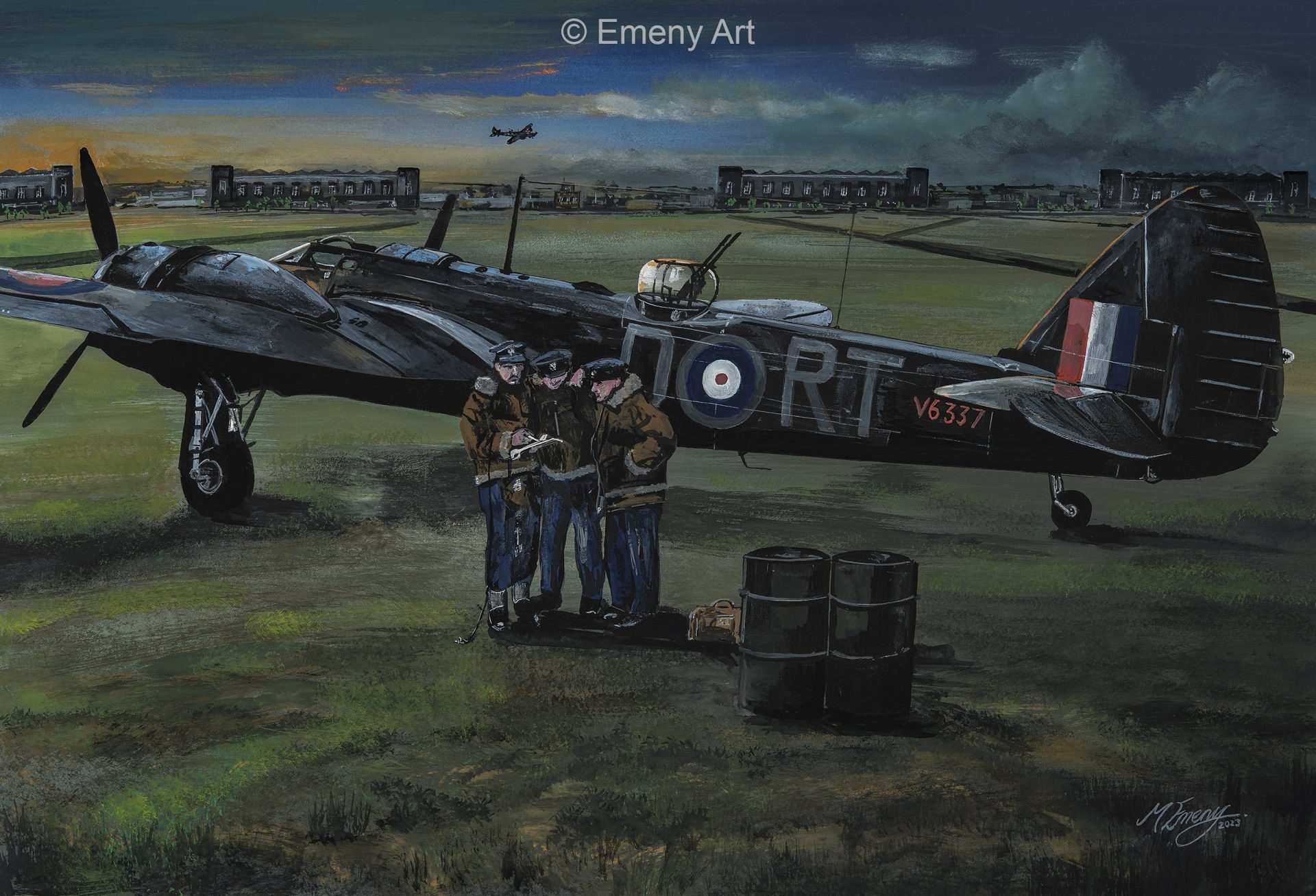
In honour and memory of two brave crews from 114 Squadron RAF, depicted at RAF West Raynham airfield, Norfolk, England; who tragically lost their lives June 2nd 1942 after both aircraft were hit by Flak.
Mk IV Bristol Blenheim V6337 (RT-D); crew shown making final plans prior to boarding their aircraft. And Mk IV Bristol Blenheim R3620 (RT-A) shown airborne.
FAREWELL MY FRIEND
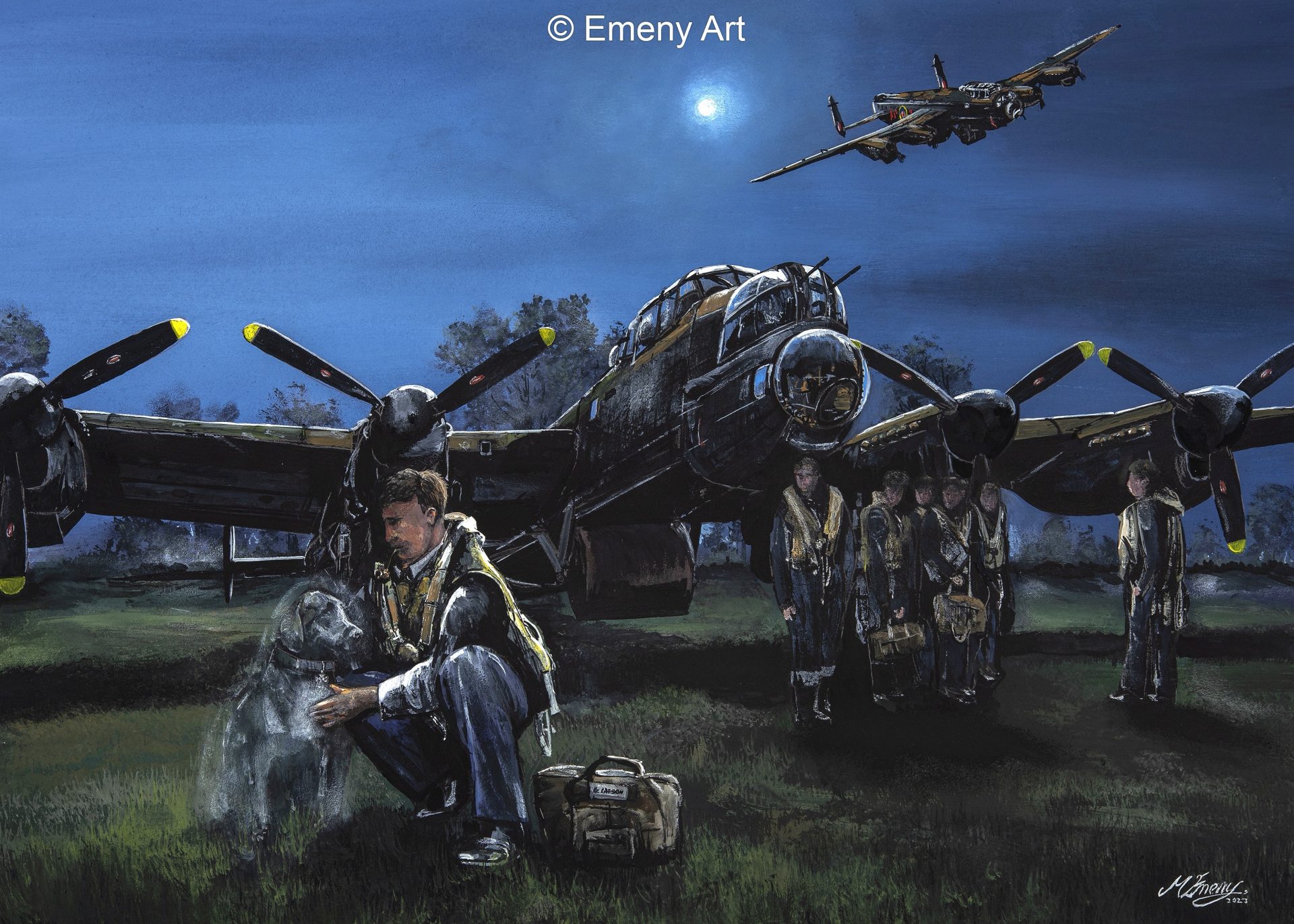
Wing Commander Guy Gibson with his trusty dog, along with the rest of his crew as they're about to board Avro Lancaster ED932, AJ-G. Wing Commander Gibson led 133 aircrew of 617 Squadron, Royal Air Force; who between them flew 19 specially adapted Lancaster bombers on a bombing raid to destroy three dams in the Ruhr valley, a heavy industrial area in Germany.
Wing Commander Gibsons dog was sadly hit by a vehicle and killed on the evening of the 15th May, the night before the operation. He loved his dog and was greatly upset by his loss. It's quite possible he said farewell to his black Labrador prior to every flight in case it was his last. His dog has therefore been depicted partially transparent in appearance; a vision of his recently lost friend.
BITTER SWEET AMBITION
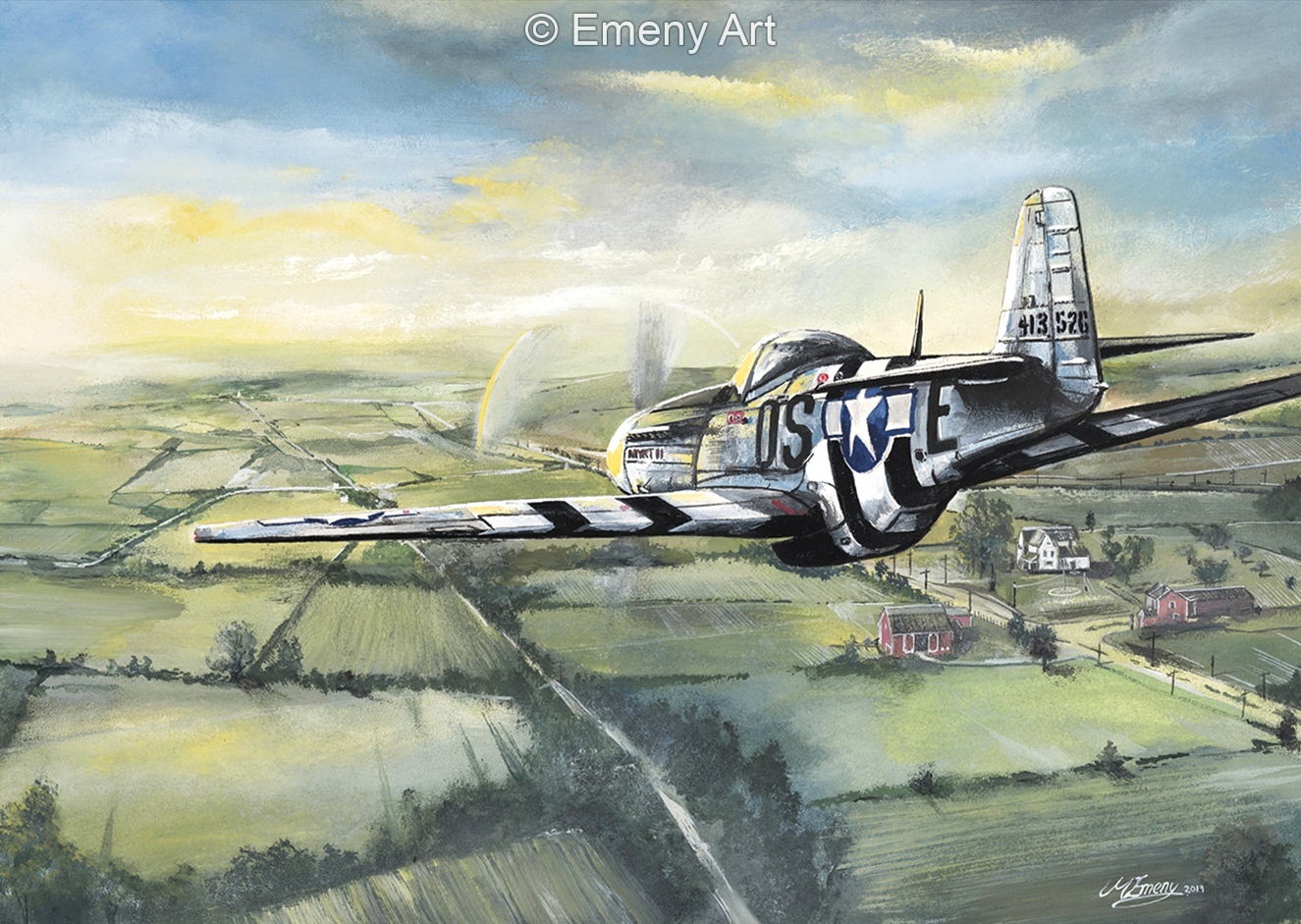
P-51D "MYRT II" NA-5 serial 44-13526 - Lieut. Leonard B. Fuller of the 355th Fighter Group, 357th Fighter Squadron (8th Air Force)
This scene shows Lt Leonard B Fuller flying over the farm he lived on and towards the cemetery where he now rests. It was one of his greatest ambitions to fly his plane over his farm.
Fuller was killed in action on July 7th 1944 when his plane was hit by flak near Blankenhain, Germany. He tragically lost his life when his parachute failed him. He was buried in the old cemetery in that same town, with his remains being repatriated in 1950. He now rests next to his parents in West Middlebury Cemetery, located near his farm in Linden, New York. Fragments of his P51D "MYRT II" were recovered from the forest near Blankenhain and brought back to the United States. A piece was placed in the earth just over Leonard's grave.
TRUE TO LIFE
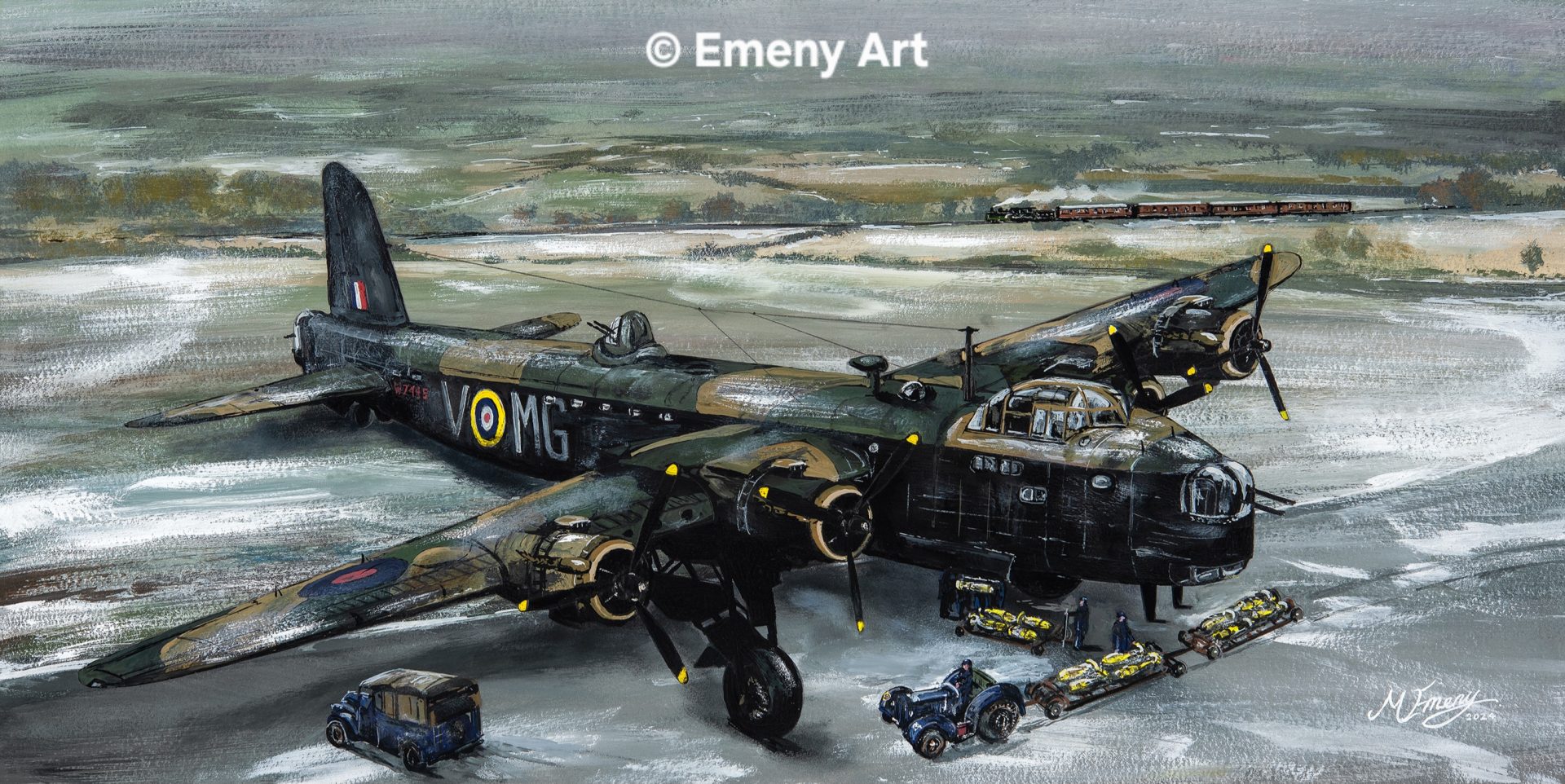
Featuring Short Stirling MG-V, W7445 of No.7 Squadron R.A.F Oakington, Cambridgeshire, England. Circa 15th November 1941. Depicted loading for a mission to the Port of Kiel; a key manufacturing facility and Port for German U-Boats.
Unable to take off successfully, struggling to gain height, the Stirling crashed into an Orchard close to Westwick Farm House, England. All but three crew members lost their lives in the crash; with a local farmer rescuing two of the injured crew.

